 English
 Spanish
 French
 German
 Norwegian
 Portuguese
 Swedish
 Italian
 Russian
 Simplified Chinese
 Japanese


Video: Mantua, Italy
Our cruise has a dramatic approach to Mantua, home of the poet Virgil, artists Mantegna and Donatello and a captivating lakeside setting. Mantua displays extraordinary neo-classical and baroque architecture, portrayed in the 14thC Ducal Palace housing some 15 gardens and courtyards, a museum, basilica and theatre. The intricate frescoes, Gallery of Mirrors and exquisite Rivers Room and 12,000 paintings and sculptures all create a Grand Finale to our Italian Renaissance adventure under the new rulers.
The imposing capital of Lombardy, Mantua (or Mantova) is a beautiful, historic city surrounded on three sides by artificial lakes created during the 12th century. Mantua’s historic power and influence under the wealthy Gonzaga family made it one of the main artistic, cultural and musical hubs of Northern Italy. Mantua’s most famous ancient citizen is the poet Publius Vergilius Maro, Virgil, who was born near the city in 70 BC. revolt backed by the House of Gonzaga led to the election of Luigi Gonzaga as the Captain General of Mantua. The Gonzagas built new walls with five gates and renovated the architecture of the city in the 14th century. During the Renaissance, the Gonzaga family raised the level of culture and refinement. In 1627, the Gonzaga line came to an end, and the town slowly declined under the new rulers.
Palazzo Ducale, the home of the Gonzaga family from the late 13th to early 17th centuries, is a huge complex of buildings, courtyards, a museum, basilica, theatre and 15 gardens. There are over 500 rooms and some 12,000 paintings and sculptures. The most famous room is the Camera degli Sposi with frescoes from 1474 painted by Mantegna.
The Duomo, the Cathedral of San Pietro, was first erected on the site of a Palaeo-Christian structure that was destroyed by a fire in 894. The church was rebuilt in 1395-1401 with the addition of side chapels and a magnificent Gothic façade. After another fire in the 16th century, the interior was remade. In 1756-1761 the façade was replaced by the Baroque one in Carrara’s marble.
The Basilica di Sant’Andrea was begun in 1462 on a site occupied by a Benedictine monastery and finished 328 years later. The Benedictine bell tower from 1414 still remains. The church holds the tomb of the painter Andrea Mantegna and a much-disputed relic said to hold the blood of Christ.
The 11th century Rotonda of San Lorenzo, the most ancient church in the city, is believed to be on the site of a Roman temple to Venus. Deconsecrated, it was used for dwellings, shops and stores. Later it was restored and the external additions removed.
In 2008 Mantua became a UNESCO World Heritage Site based on its Renaissance planning and architecture.
Related Articles
Family-Friendly Barge Cruises: European Adventures for All Ages
Enjoy unforgettable family-friendly barge cruises through Europe’s scenic waterways. Experience kid-friendly activities, cultural excursions, and all-inclusive comfort—perfect for multi-generational holidays and adventures for all ages. Read More
Venetian Gondolas: History, Facts & Must-Know Tips
With their sleek black hulls and timeless elegance, Venetian gondolas are an enduring symbol of the Floating City. Though only a few hundred remain today, these iconic boats continue to... Read More
Our Top Destinations for Spring in Europe
Here are our most highly recommended cruises for those seeking barges, birds and blooms this springtime. Read More
Italian Cruises: A Guide to Our Sensational River Cruises
Thinking of taking one of our river cruises in Italy? One of our top destinations and this short video shows you why guests love it so much! Read More
Discover the Delights of Italian Cheese: A Comprehensive Guide

Italy produces approximately 600 different types of cheeses, and some of their most famous cheeses date back centuries, or even millennia years in the case of Pecorino Romano Read More
Italian Wine Guide: Everything You Need to Know
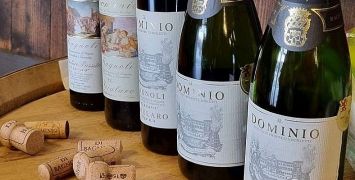
Guide to Italian wines including wine regions, categories, classifications, how to read the label and more! Read More
The Ultimate Guide to Cruising the Po River in Italy
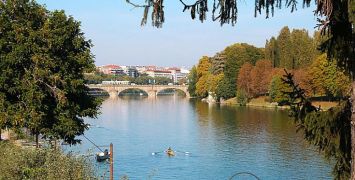
Italy’s longest river, the River Po flows through many important cities through its 562km course, including Turin, Piacenza, Cremona and Ferrara. Read More
Italy Cruises: Everything You Need to Know
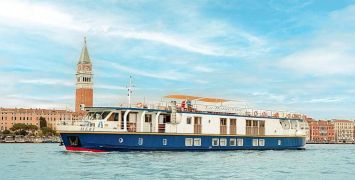
A river cruise in Italy with European Waterways is a fantastic introduction to this wonderful country, with something for every kind of traveller. Read More
The History of Venice: Italy’s Historic ‘Floating City’
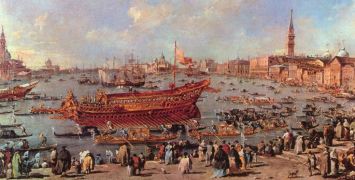
The Venetian Lagoon is an ambiguous area that is neither land nor sea. Stretching some 34 miles in length and 7 miles wide, it takes a crescent shape along... Read More