 English
 Spanish
 French
 German
 Norwegian
 Portuguese
 Swedish
 Italian
 Russian
 Simplified Chinese
 Japanese


Did you know, when you book a cabin aboard La Bella Vita departing on June 01 & 22; July 20, you can enjoy a FREE gondola ride through Venice’s waterways? Contact our Sales Team, or read on to find out more about these elegant and iconic vessels…
Venetian Gondolas: History, Facts & Must-Know Tips
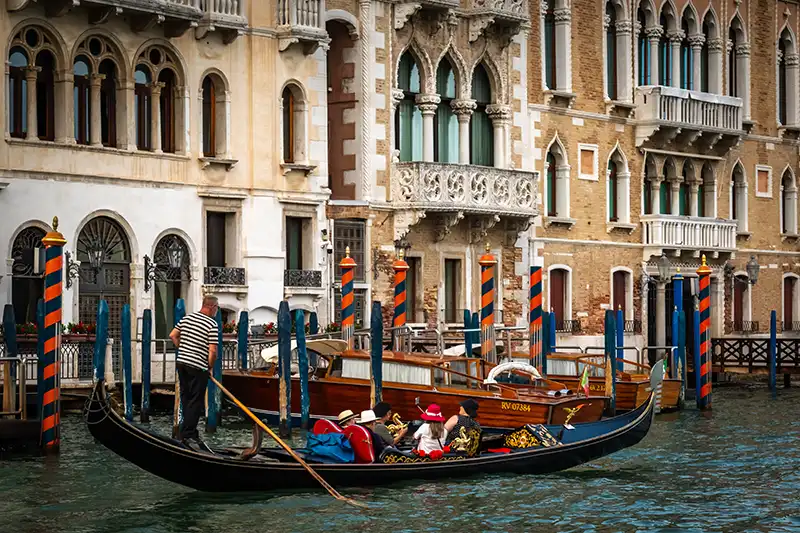
Alongside the intricately-carved Venetian gondolas, Venice’s canals bustle with a diverse array of motorboats. The city’s iconic vaporetti – public water buses operated by the municipal transport system – glide through the waterways, while sleek private water taxis ferry passengers in style. Beyond these, a fascinating mix of specialised vessels adds to the ever-changing scene: barges laden with fresh fruit and vegetables, waste collection boats, ambulance and police launches, and even boats piled high with tourists’ luggage. Together, they create a vibrant and dynamic waterway teeming with life and colour.
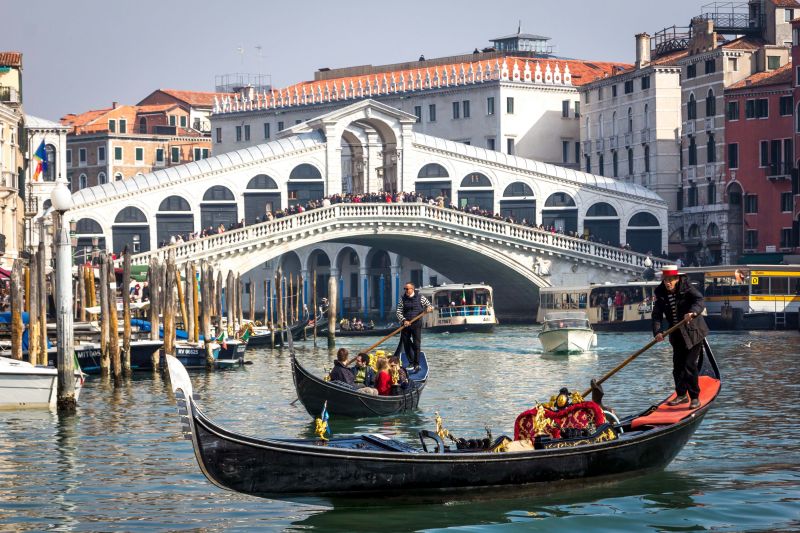
Venice’s unique landscape is as much a reflection of its economic history as it is of its physical environment. The city’s wealth was built on maritime commerce, beginning with local trade in fish and salt from the lagoon before expanding into a thriving hub for goods moving between Europe, the Middle East, and Asia.
To sustain its vast trade network, Venice required sturdy, well-crafted vessels – not only for transport but also for protection against pirates, rival merchants, and the Turkish navy. This necessity gave rise to a booming shipbuilding industry, centred in the northeast of the city at the legendary Arsenal. This vast complex of basins, shipyards, and workshops produced everything from sails and ropes to weaponry, cementing Venice’s status as a dominant maritime power.
A Symbol of Venice
Perhaps the most iconic form of Venetian transport is the gondola. Once a common sight on the canals, only a few hundred of these sleek, keel-less boats remain today. Their elegant black paintwork and distinctive curved shape have become enduring symbols of Venice. For centuries, writers have romanticised gondola rides, and even now, tourists eagerly pay a premium to be rowed through the canals at twilight, often serenaded by a gondolier.
However, the days when Venetian gondoliers could recite verses from poets like Ariosto or Tasso as they navigated the winding waterways are long gone. While a handful of gondolas still function as ferries across the Grand Canal, their high maintenance costs threaten their continued existence.
Designed to suit the unique conditions of Venice’s canals and lagoon, gondolas are propelled by a single gondolier using a specialised oar. Their asymmetrical design enhances manoeuvrability, making them remarkably efficient in narrow waterways. Once the primary mode of transport in the city, gondolas now serve mainly as tourist attractions. Yet, despite their declining numbers, they remain an enduring emblem of Venetian heritage.
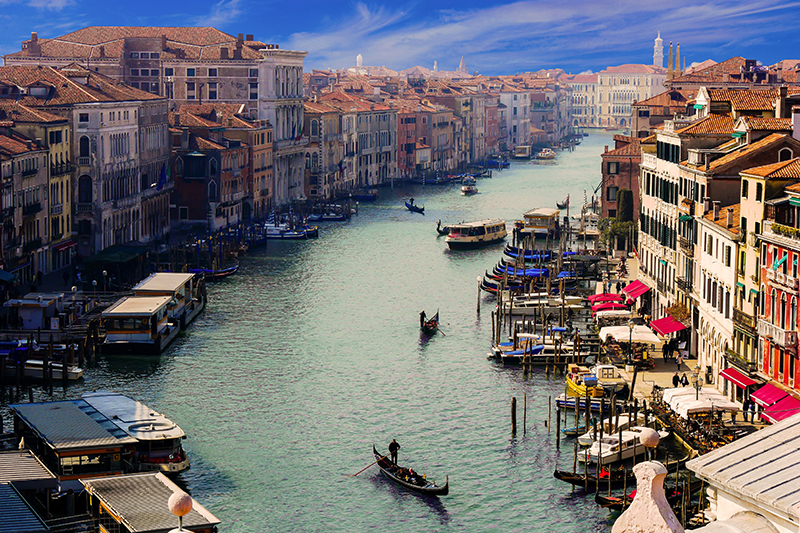
Venetian Gongolas - The Devil is in the Detail
Every detail of the Venetian gondola carries its own symbolism. The distinctive iron prow-head, known as the fero da prorà or dolfin, serves a practical purpose – balancing the weight of the gondolier at the stern – while also holding deep symbolic meaning. Its inverted ‘S’ shape is said to reflect the winding curves of the Grand Canal.
Beneath the main blade, a comb-like structure with six forward-facing teeth (rebbi) represents the six districts (sestieri) of Venice. A smaller, rear-facing prong symbolises the island of Giudecca. The curved top is thought to resemble the Doge’s cap, while the semi-circular gap between the top and the six prongs is often linked to the iconic Rialto Bridge. Some gondolas also feature three decorative friezes between the teeth, representing the three principal islands of the Venetian Lagoon – Murano, Burano, and Torcello.
However, this intricate symbolism may be a more modern interpretation, shaped by the need to explain the gondola’s form to visitors. Historical records do not reference these meanings before the current evolution of the fero, suggesting that the design came first, with the symbolism following later.
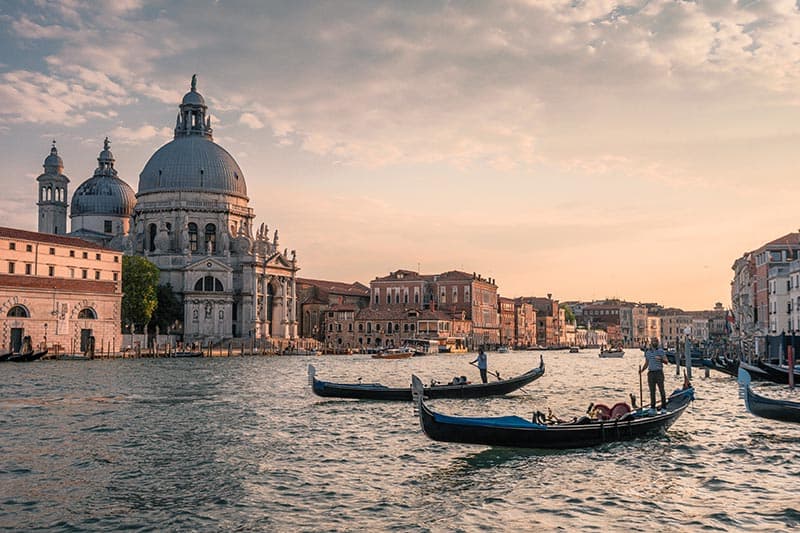
How do Venetian Gondolas Work?
The gondolier stands at the stern, facing the bow, and propels the gondola with a distinctive rowing technique. Each forward stroke is followed by a compensating backward stroke to maintain balance and direction. The oar rests in an intricately carved wooden oarlock, designed to extend from the side of the boat. This unique structure allows even the slightest resistance from the return stroke to subtly realign the bow, keeping the gondola on course.
A Brief History of Venetian Gondolas
The Venetian gondola has been a part of Venice’s waterways since at least the 11th century, first mentioned by name in 1094. At its peak in the 17th and 18th centuries, an estimated 8,000 to 10,000 gondolas filled the canals. Today, only around 400 remain in active service, with a handful privately owned – typically hired out for Venetian weddings or used in racing events.
Although the gondola is now an enduring symbol of Venice, it was far from the only mode of transport during the Republic’s era. A 1500 map of Venice by Jacopo de’ Barbari shows that gondolas made up only a fraction of the city’s boats, with the majority being galleys and other vessels.
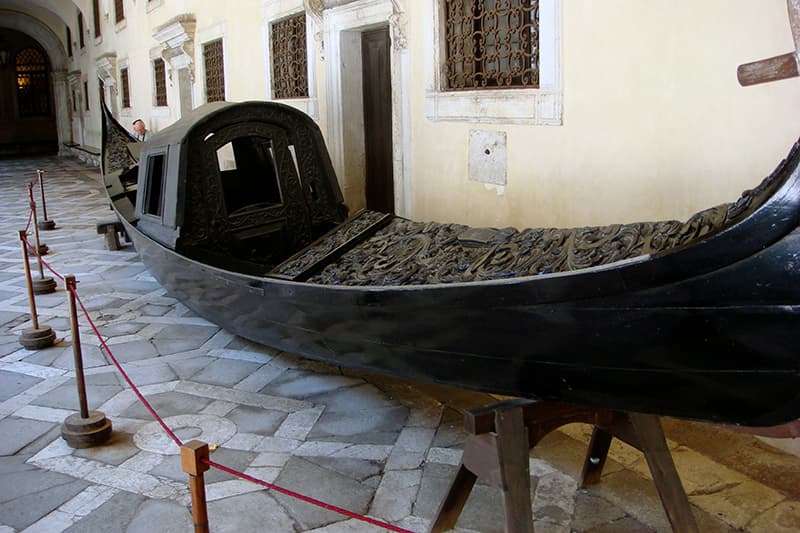
The gondola’s design has also evolved significantly over time. Paintings by Canaletto and other artists depict earlier versions with a lower prow, a taller fero, and often two rowers. The distinctively curved, banana-shaped gondola seen today was introduced in the 19th century by boatbuilder Tramontin, whose family still operates their renowned boatyard. Gondola construction continued to develop until the mid-20th century, when the city government prohibited further modifications.
Due to its flat-bottomed hull, a gondola can be manoeuvred sideways when needed, but contrary to popular belief, it is never poled like a punt – the canals of Venice are too deep. Until the early 20th century, gondolas were often fitted with a felze, a small cabin that sheltered passengers from the elements and prying eyes. These enclosed cabins, with windows featuring louvered shutters – the original ‘Venetian blinds’ – eventually disappeared, possibly due to tourists’ preference for an unobstructed view. A summer awning, the tendalin, persisted for a time as a vestigial replacement.
While gondolas were once painted in a variety of colours, a sumptuary law eventually mandated that all Venetian gondolas be painted black – a tradition that continues to this day…
How much does a gondola ride cost in Venice, Italy?
The cost of a Venetian gondola ride varies depending on several factors, such as location, duration, and time of day. In general, gondola rides in popular tourist destinations such as Venice, Italy, can range from 80-120 euros for a 30–40-minute ride. Prices may be higher during peak tourist season or for evening rides. It’s always recommended to check with local gondola tour operators or online booking sites for the most up-to-date pricing information.
How much does it cost to buy a new Venetian Gondola?
Today’s gondolas are up to 11 metres long and 1.6 metres wide and weigh approximately 350 kg (700lb). Made from 280 pieces of hand-made sections from eight different types of wood – including lime, oak, mahogany and walnut, a gondola can take up two months to construct and today the price of a new gondola is somewhere in the vicinity of €40,000.
Discover Venice aboard La Bella Vita
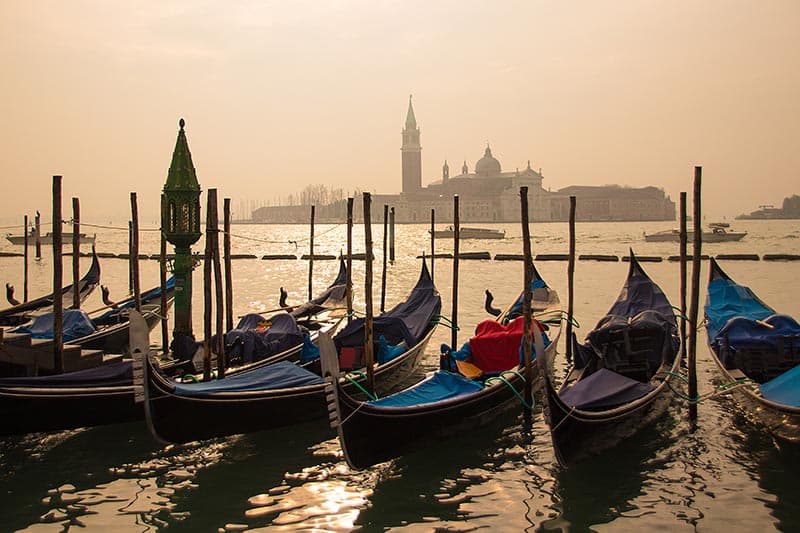
European Waterways guests joining hotel barge, La Bella Vita are met in Venice, offering the perfect opportunity to sample a Venetian gondola, before joining the week-long cruise between Venice and the Renaissance city of Mantua. La Bella Vita also offers a Venetian Lagoon Cruise, visiting the islands mentioned above plus so much more. For more information delivered to your doorstep, order a free copy of our brochure or perhaps have a no-obligation chat with a member of our team via our Contact Form.