 English
 Spanish
 French
 German
 Norwegian
 Portuguese
 Swedish
 Italian
 Russian
 Simplified Chinese
 Japanese


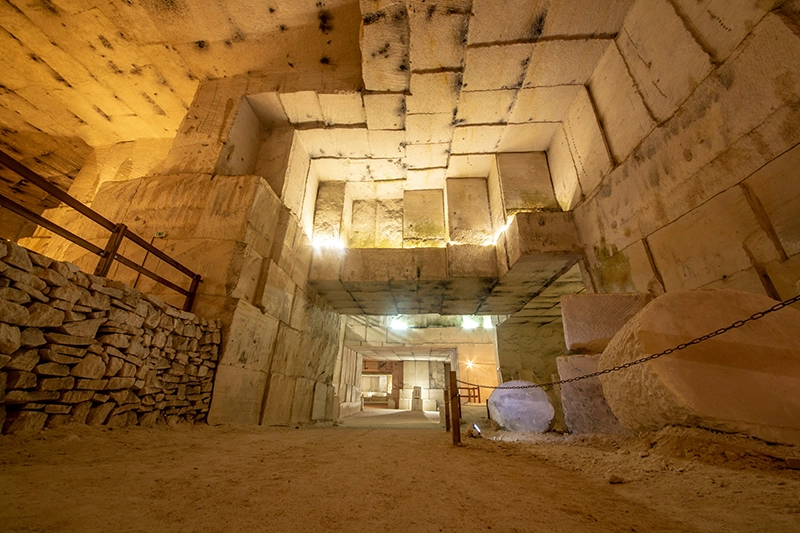
Travel with us aboard luxury hotel barge, L’Art de Vivre, and you will visit a truly unique site. Aubigny is an ancient underground quarry, often referred to as a subterranean stone cathedral. With cut rising pillars and high vaulted ceilings, it is pure drama on a visually large scale.
Aubigny Quarry: The Ancient Underground Wonder That Built Paris
Nestled on the edge of the village of Taigny in Burgundy, Aubigny began life as a fief belonging to the Count of Nevers in the 1500s. Over the centuries, it has passed down through the generations, until the tumult of the French Revolution.
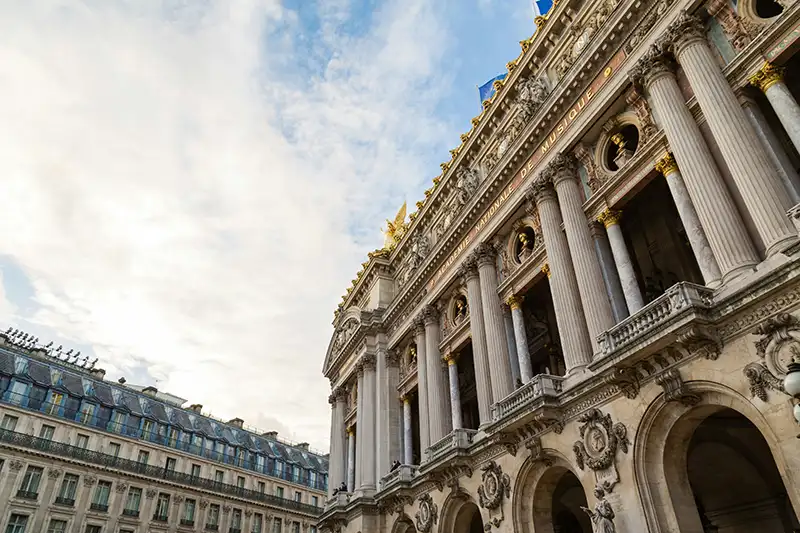
Set within the serene landscape of rolling hills and farmland, Aubigny is located within the Portland limestone plateau of Forterre. This region’s high-quality stone has long played a vital role in the construction of both local civic buildings and some of Paris’ most iconic structures, including the Paris Opera House. Quarrying at Aubigny continued until World War Two, and the site opened to the public in 1992.
A Journey Through Stone
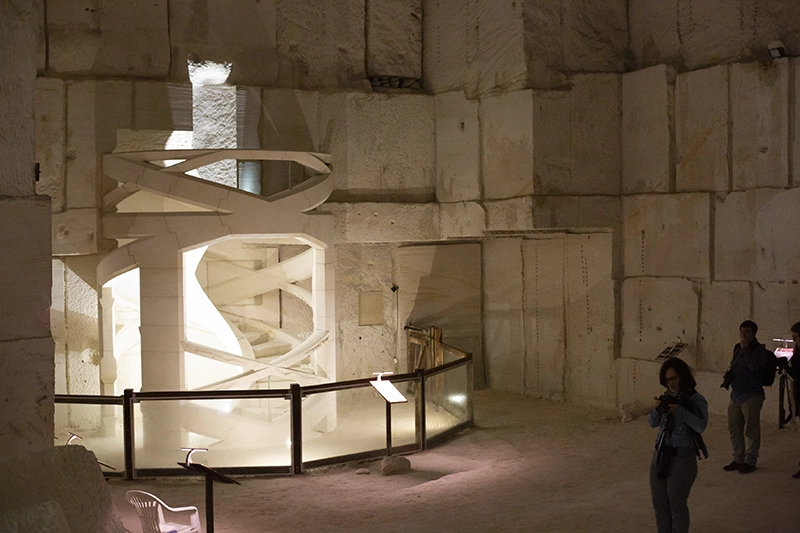
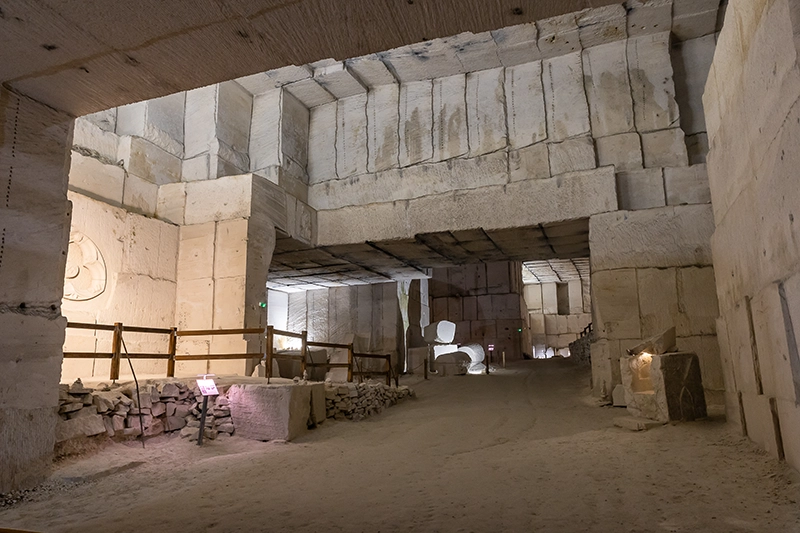
Known as the La Carrière d’Aubigny in French, this site was never just an ordinary quarry – it evolved into a subterranean marvel and has been likened to a subterranean cathedral carved out of the stone. With its precisely carved grid like cuts, intricate masonry and the use of atmospheric lighting, the quarry creates a truly immersive experience. As you explore its 16 rooms, spanning nearly 4 acres, you’ll step into a space that showcases the craftsmanship and ingenuity of centuries of stonemasons.
Though no longer in operation, the quarry has been carefully restored to highlight its history and the stonework that made it famous. The site offers a rare opportunity to witness the grid patterns left by the quarrymen on the walls and ceilings, as well as sweeping arches and intricate carvings that showcase the skill of stonemasons who have carried on this ancient craft. Beyond its fascinating history, Aubigny’s limestone also contributed to the construction of many of Paris’ grandest buildings.
There are displays of the original tools used to both mine the rock and craft it into the more decorative pieces, illustrating the detailed and precise work done by masons. A very unique experience, this hidden labyrinth is purposefully lit to showcase the stonework detail.
A Geological Journey
The Aubigny Quarry takes its stone from the Jurassic Age, dating back 157–159 million years. These layers of marine-sedimented limestone formed when granite protuberances, originally 500 million years old, sank into tropical seas over 195 million years ago. Tiny fragments of ancient marine life compressed over millions of years to create this beautiful stone.
Fast forward to Roman times, and archaeological evidence confirms that the quarry was already in use in the 1st century AD, and remained an important source of stone through the centuries. In the 19th century, Baron Haussmann – the visionary behind the Parisian cityscape we know today – turned to Aubigny for his grand architectural projects. Beyond the Paris Opera House and Town Hall, Aubigny limestone was used in the construction of The Louvre, the National Library, the Hôtel-Dieu, and even the massive bases of the Eiffel Tower.
But Aubigny’s impact extends beyond Paris. Throughout the Yonne region, its limestone has shaped châteaux, churches, monasteries, and even village houses. Its warm, creamy tones lend a distinctive charm to the landscape – one well worth exploring and admiring.
A Monument to Ingenuity
As you stand in this vast subterranean time capsule, you will have the opportunity to appreciate the precision of the quarrying process. The massive blocks of stone were not blasted from the rock face, but carefully extracted with remarkable skill. Quarrymen used long iron rods, driving them by had into the stone in a grid-like pattern of vertical and horizontal lines. Three sides of the block would be chiselled away, while wooden wedges would be inserted into the fourth. Soaked with water, the wood expanded gradually splitting the stone from the rock face.
Great care was taken before releasing each block to prevent breakage. The stone had to be cushioned as it fell, ensuring it remained intact. The larger the blocks, the more flexibility they offered to stonemasons at their final destination, allowing for greater precision in the architectural projects.
Shaping Paris
In the cool depths of the Aubigny Quarry, the chisel marks on the rock face reveal the immense effort required to extract each massive stone block. It’s awe-inspiring to imagine the process – horses hauling the heavy stones to the surface, where they were loaded onto carts and transported to the River Yonne. From there, they were loaded onto boats, beginning their journey to Paris to become part of the city’s iconic architecture.
Importantly, throughout their journey, the stone blocks would have been covered and kept damp. Upon arrival, they were cut into smaller, more manageable pieces, before being “dressed” – a meticulous process of chiselling away excess stone to achieve the desired shape, size and smooth finish. Once perfected, these dressed stones became the building blocks, of Paris’ most iconic landmarks.
Once in place the stone would begin to slowly dry out. This process sweated out the calcite in the rock, which then hardened the stone, giving it a thin yet incredibly protective outer skin. As you pass through villages of these cream-coloured stones, you’ll notice how clean and reasonably free of grime they remain. This enduring freshness is a result of that natural process. As long as the hardened outer layer stays intact, The stone remains resistant to the elements, unaffected by weathering.
Preserving the Past
Quarrying ceased during World War Two, and over time, the site fell into disrepair. It became an underground dumping ground for discarded waste and even served as a cultivation site for the quintessential Champignons de Paris mushroom due to its cool, humid environment. Concerned about the state of their heritage, local residents banded together to restore the quarry, determined to transform it into a celebration of traditional stone-carving skills.
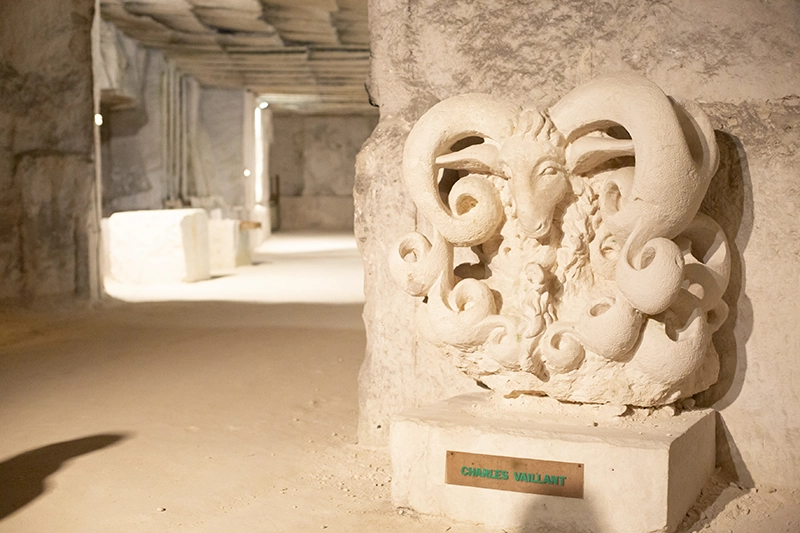
Today, the quarry is illuminated with subtle, yet stunning lighting that enhances the vastness of the space. The intricate patterns left behind by the stone-cutting process stand as a testament to both the hard work and the artistry of the masons. Stone sculptures created by the Compagnons du Dévoirs – a group of highly skilled artisans who dedicate themselves to mastering traditional crafts – can be spotted throughout the quarry. These works are showcased against the golden glow of the limestone itself.
Visiting the Aubigny Quarry is akin to exploring cathedrals or other monumental structures – one is left in awe of human initiative, determination and skill. Its underground location only adds to its uniqueness and sense of wonder, making it a truly unique site to explore.
Discover the Aubigny Quarry aboard L'Art de Vivre
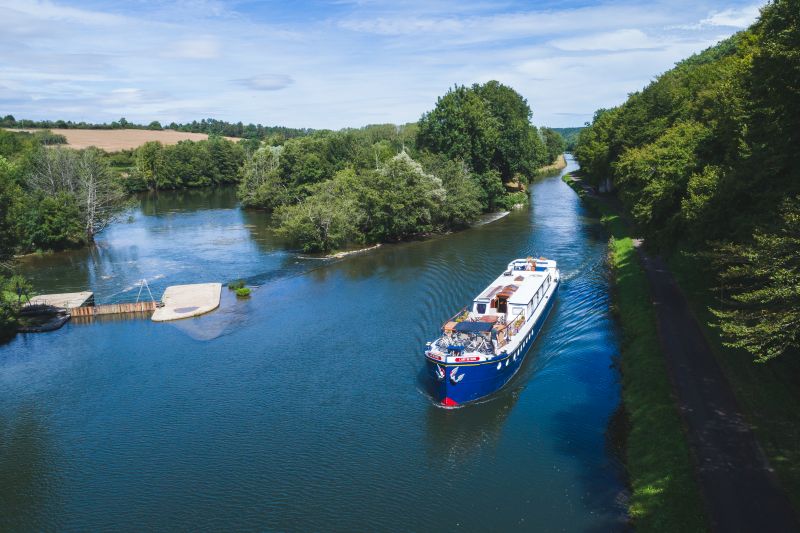
Guests joining the Classic Cruise aboard hotel barge L’Art de Vivre on Burgundy’s Canal du Nivernais will get to experience a visit to the Aubigny Quarry for themselves. to view her full itinerary, click here.
For more information delivered to your doorstep, order a free copy of our brochure or perhaps have a no-obligation chat with a member of our team via our Contact Form.