One of the joys of a hotel barge escape is the chance to learn the fascinating history of the waterways which pass beneath your feet. Whether you’re cruising through a natural river gorge or amongst an awe-inspiring feat of human engineering, there are plenty of spectacles to surprise you during your journey.
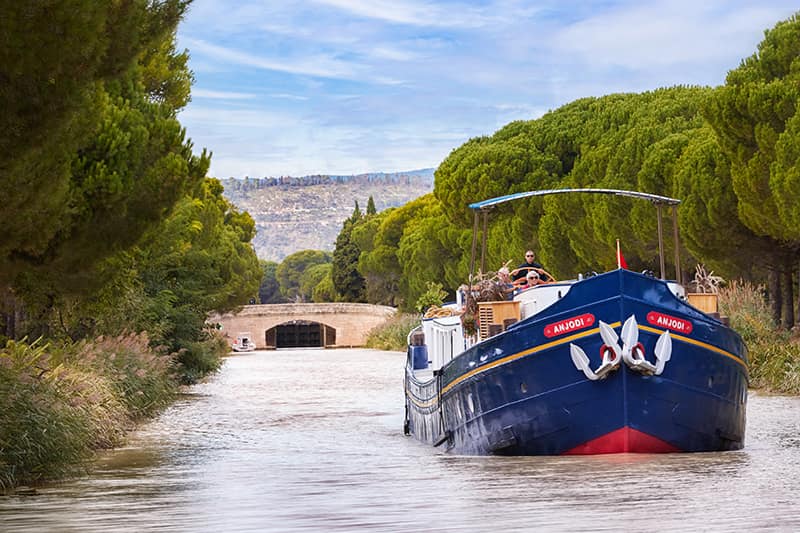
Engineering enthusiasts who choose to cruise the Canal du Midi in France aboard Anjodi are treated to a particularly interesting experience: the Tunnel at Malpas. Also known as Voûte du Malpas (Vault of Malpas) or the Grotte du Malpas (Cave of Malpas), it is Europe’s first and thus oldest navigable canal tunnel.
Carving Out the Canal du Midi
In the reign of King Louis XIV, a 241 km canal was commissioned in order to provide a trade route for wheat from the Languedoc region. For 15 years the chief engineer, Pierre-Paul Riquet, struggled with the challenges of such an ambitious project: constructing the Canal du Midi. The finished canal is one of the most impressive feats of 17th century engineering, and in 1996 it was awarded UNESCO World Heritage status.
Along the way, the Canal du Midi cuts through a hill that separates the valleys of the Aude and the Orb at a site called ‘Le Malpas’, or ‘bad passage’ in Occitan (A portent of things to come?). Not only is it the only tunnel along the canal, it astonished contemporaries because it is the first time in history that a navigable canal was designed to go underground.
Building the Malpas Tunnel
The excavation of the Malpas Tunnel is one of the most important chapters in the canal’s construction. In 1679, the project had reached the hill d’Ensérune in Hérault. The hill had already been the location of a smaller aqueduct tunnel to drain the Étang de Montady during the Middle Ages, several centuries beforehand. Riquet reportedly drew inspiration for the Malpas Tunnel from this existing tunnel with the plan to dig through the hill to form a new larger shaft.
However, there were many detractors to this route as it took the canal further away from the city of Narbonne which was of great importance, potentially harming it economically. So, when initial excavations revealed that it was formed of brittle sandstone called ‘tufa’ that was liable to collapse, the powers-that-be were alerted.
Works on the Midi are Halted
This was a serious blow to the project. The prime minister, Jean-Baptiste Colbert, immediately stopped the work when he heard the news and requested that the canal should be rerouted to cross the River Aude rather than pass through the hill.
However, this option was no more attractive to Riquet; carrying the canal over the River Aude came with its own set of problems, particularly with regards to potential flooding. Instead, he ordered that the tunnel should be dug out in secret by his master mason, in spite of the dangers involved. In just eight days, the Malpas Tunnel was complete, with a lined ceiling throughout.
The Malpas Tunnel or Passage?
A curious side note, the French word ‘tonnelle,’ which describes the rounded shape of a barrel, is thought to be the source of the English word ‘tunnel.’ This word entered our language during the building of railroad tracks, for which many tunnels were excavated. Authors from the 17th and 18th centuries most frequently used the words ‘vault’ or, less frequently, ‘cave’ to refer to the Malpas passage, never using the word ‘tunnel.’
There is in fact a third tunnel at Malpas! The Béziers to Narbonne railway line is housed in a tunnel that was dug in the nineteenth century through the Hill d’Ensérune and is beneath the Malpas canal tunnel. You will hear the train if it passes whilst you are traversing through on the Canal du Midi.
The Malpas Tunnel Today
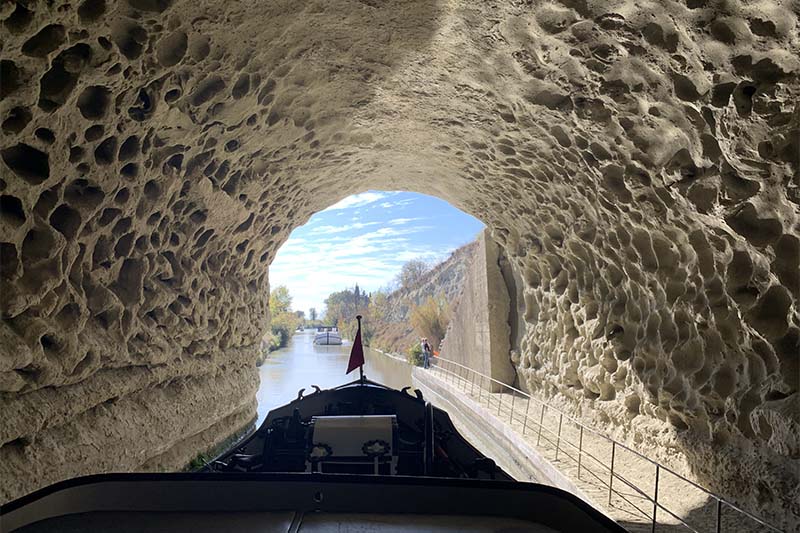
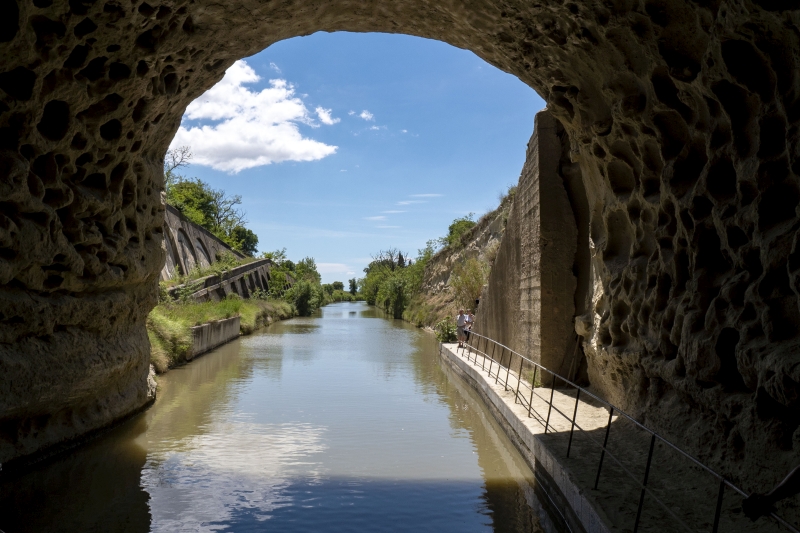
As a guest aboard Anjodi, you are treated to a first-hand view of the tunnel when you cruise the Canal du Midi. Although relatively short, at 165 metres-long, it is remarkably wide and high with a vaulted roof that rises 8 metres above the surface of the water.
In the era of Riquet, the tunnel was not arched. The arching was brought in for reinforcement around 1700. However, near the Capestang end, about 50 metres still don’t have arches, and the hewn rock is visible as you cruise below. Some cavities in the rock surface, the deepest of which measures 60 centimetres, have appeared due to humidity and erosion over three centuries but the structure remains strong. This tufa rock is therefore not as soft a rock as was initially believed.
It remains, over 350 years later, a monument to Pierre-Paul Riquet’s determination and ingeniousness.
Discover the Malpas Tunnel aboard Anjodi
Ready to cruise the Malpas Tunnel? If you’ve been inspired and would like to experience our luxury barge cruise aboard Anjodi for yourself, why not speak to a friendly member of the European Waterways cruise team. Alternatively, order a brochure to consider all of our cruise options!
 English
 Spanish
 French
 German
 Norwegian
 Portuguese
 Swedish
 Italian
 Russian
 Simplified Chinese
 Japanese