English
 Spanish
 French
 German
 Norwegian
 Portuguese
 Swedish
 Italian
 Russian
 Simplified Chinese
 Japanese


There are so many beautiful towns to explore in the South of France – one of our favourites is the compact and characterful city of Narbonne on a Canal du Midi cruise. Located on a vine covered plain nine kilometres (15 miles) from the Mediterranean Sea, to the east of Carcassonne. This mid-sized city is known for its stunning architecture, cuisine and rich history.
Narbonne: Sightseeing in Southern France
The Building Blocks of History
Narbonne went through a variety of changes in its formative years. Begun in 118 BC, it was the first town established by the Romans in Gaul, originally called Narbo Martius, from which its current name derives. It was built along the first Roman road in Gaul connecting Spain to Italy. In 462 it was handed over to the Visigoths, ending Roman rule. From 719 it came under Arab rule as part of the Umayyad Caliphate.
Then in 759, the Carolingians, under Pepin the Short, conquered the city when it became a centre for Judaism. In the 11th and 12th centuries the city shifted yet again under the Capetian dynasty. The city began to decline in its importance and prosperity in the 14th century, particularly because the river Aude changed course. This change in fortunes is showcased in the Narbonne Cathedral.
Cathedral of Saint-Just and Saint-Pasteur
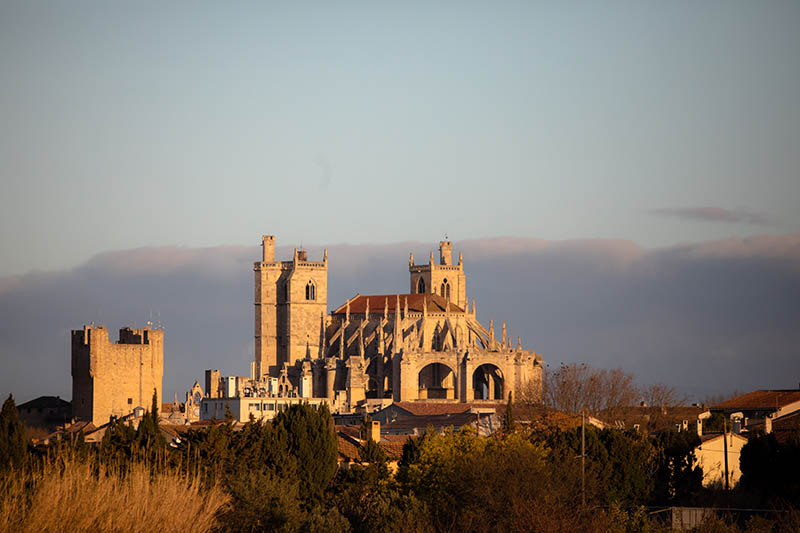
One of the most imposing sites in the city is the Gothic cathedral. It was built in the 13th century in the style of the great cathedrals of northern France, with impressive flying buttresses, soaring stained glass windows and a vaulted choir. However, this beautiful structure was never finished – there is no knave or transept, as constructing these would have meant knocking down part of the city’s defensive ramparts. This was considered unwise at this troubled time when defence against attack was a very real concern.
We would recommend taking a look at the cathedral’s Treasury, which houses a remarkable collection of liturgical objects. These treasures – which include a sixteenth-century tapestry depicting The Creation, an eleventh-century pyxis and a carved ivory plaque from the ninth century – reflect the immense wealth and status of the medieval Archbishops of Narbonne.
Archbishop’s Palace and the Via Domitia
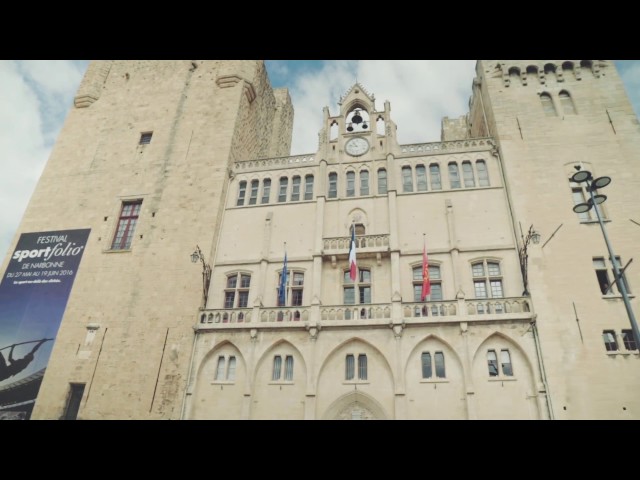
The Archbishop’s Palace can be found nearby in the centre of Narbonne. It has multiple towers and consists of two palaces: the Romanesque Palais Vieux and the Gothic Palais Neuf. Although it started as the modest residence of the town’s ecclesiastical elite, it is now the grand setting for Narbonne’s Town Hall, as well as the Museum of Art in the old apartments and the Archaeological Museum in one wing.
Just outside the palace you will notice an exposed section of Roman road. This was once part of the Via Domitia, built in the second century BC as a vital access route from Rome in the west to the Cadiz in the east. Narbonne was the capital of the ancient Roman province of Narbo Martius, the first Roman colony in Gaul. This glimpse of the road’s original surface is a reminder of the city’s important ancient past.
The Horreum
Speaking of Narbonne’s ancient past, under the centre is a labyrinth of ancient warehouses known as the Horreum, (“warehouse” in Latin), left over from the town’s days as a Roman port. Classified as a historic monument since 1960, archaeologists began excavating it as far back as the early 1800s.
A series of underground galleries covering a surface area of about 200m (over 2,000 square feet), they were opened to the public in 1976. Entirely vaulted, there are three wings forming a ‘U shape’. A long central corridor is found in each wing, with smaller rooms leading off from it. These galleries were built by the Romans as foundations, but also as storage and a barrier against rising damp.
Narbonne Today
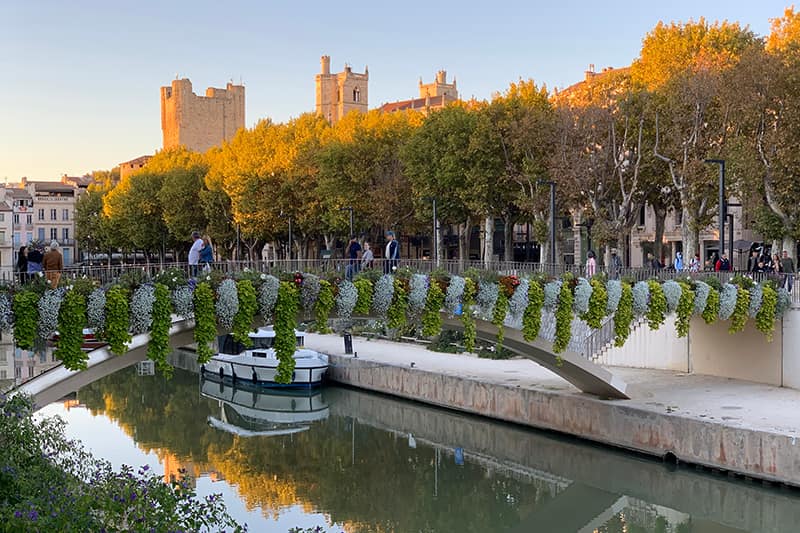
Narbonne is a beautiful city, a hidden gem of southern France, with its colourful and beautifully decorative houses. Passing through the city’s centre, the Canal de la Robine, a branch of the Canal du Midi, plays host to the Promenade des Barques, a lovely tree lined walk. Charming shops and restaurants border the canal and the famed Pont des Marchands, which dates back to Roman times.
The Pont des Marchands, or “Merchants Bridge”, is a unique bridge spanning the canal with a road crossing over, as well as houses and shops on either side along the bridge. It is one of only a small number of bridges with buildings on it worldwide today. Not only can you walk over it, but under as well, as the canal’s stone towpaths pass underneath on both sides.
Les Halles, a Beautiful Market
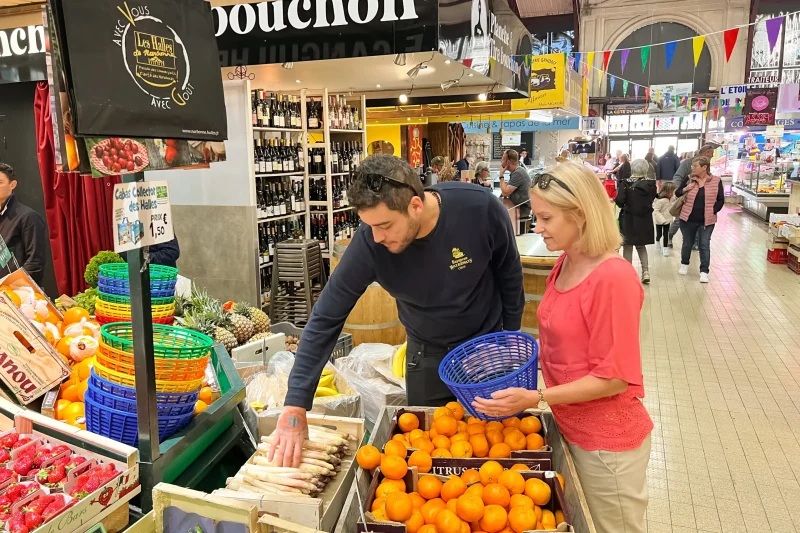
There is a centuries-old covered market, ‘Les Halles’, in the city centre that is open every morning until 2pm. Considered one of France’s most beautiful markets, it is well worth a visit to its bustling interior where you can buy everything from olives to oysters. Join in the purchasing, tasting, and discussions or rest yourself at a cafe or one of the bars at its centre and watch in wonder.
Begun in 1871, as a place for fishermen and farmers to sell their wares, it went on to develop and showcase its “Belle Epoque” style. Many of the early seller stalls are still there! Oulès Cheese stall is the most famous, having moved into Les Halles in 1901 when the market opened. Look out for butchers selling a variety of meat types, as well as stalls selling fish, breads and pastries, and of course vegetables.
Narbonne Sings
You may be familiar with the famous song ‘La Mer’ or possibly ‘Boum’. Both were written by the renowned songwriter Charles Trenet who was born in Narbonne, in 1913. The tune of La Mer went on to be used in Bobby Darin’s ‘Beyond the Sea’.
A prolific writer of both music and lyrics, he wrote almost 1,000 songs in his lifetime! Many of his songs refer to places from his surroundings, including around Narbonne. In 2000, the house he was born in at 13 Avenue Charles Trenet was turned into a small museum containing amongst home life memorabilia many drafts of the original songs that made him famous.
Exploring Narbonne on a Barge Cruise
A trip to Narbonne features on all of our Classic Cruises of the Canal du Midi. If you would like to explore its unique blend of Roman and medieval history yourself, don’t hesitate to get in touch with our sales team and book your barge cruise today.
Discover our Canal du Midi cruises:
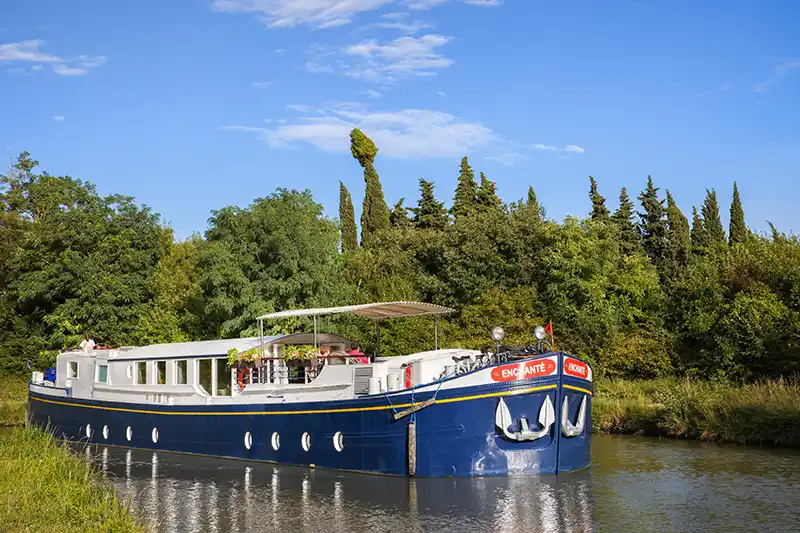
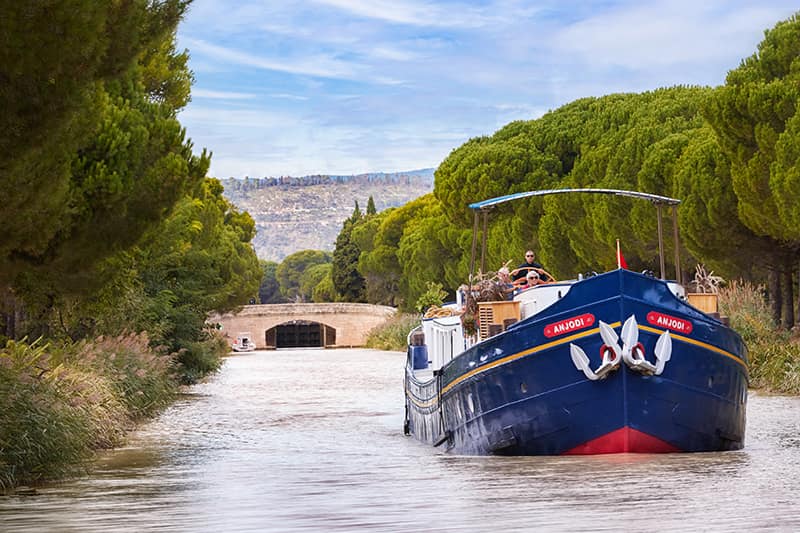
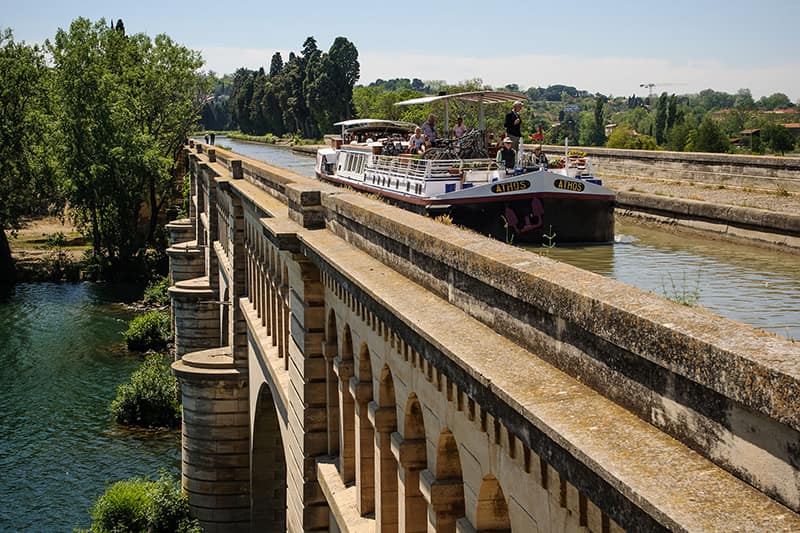
Enchanté | Anjodi | Athos